For the love of art since silent movies
The debut film on November 30, 1924, was Imperial Violets, by Henri Roussell and Raquel Meller. At the time, the cinema was silent, so the exhibition was accompanied by a string sextet conducted by violinist Nicolino Milano. The following year, in 1925, the theater gained prominence with the founding of the company Teatro Novo, directed by António Ferro. In the same year, the first presentation of a Portuguese film took place, Os Olhos da Alma, by Virgínia de Castro and Almeida by Roger Lion.
Throughout the 1930s there was a need to purchase sound equipment and on November 5, 1930, the first film with sound premiered, The Love Parade, with Maurice Chevalier and Jeanette MacDonald. In 1934 the first Portuguese sound film, Gado Bravo, by António Lopes Ribeiro was released. The silver anniversary is then celebrated in 1949, with a show that brought together the Portuguese Ballets, the Fado by Amália Rodrigues (where the theme O Fado by Eugénia Câmara premiered, with music by Raúl Ferrão and lyrics by Pereira Coelho) and the Orchestra Tavares Beautiful. In the 50’s the Theater was in need of improvement works to renovate some areas, such as widening the stage, the cinema projection booth and the basement. Works were carried out once again by Raúl Lino and, in 1959, Ben-Hur was released as the first film in a cinemascope system. 1966 was marked by The Sound of Music, and the movie kept the record for being in display for ten months in a row, followed by more financially complicated years.
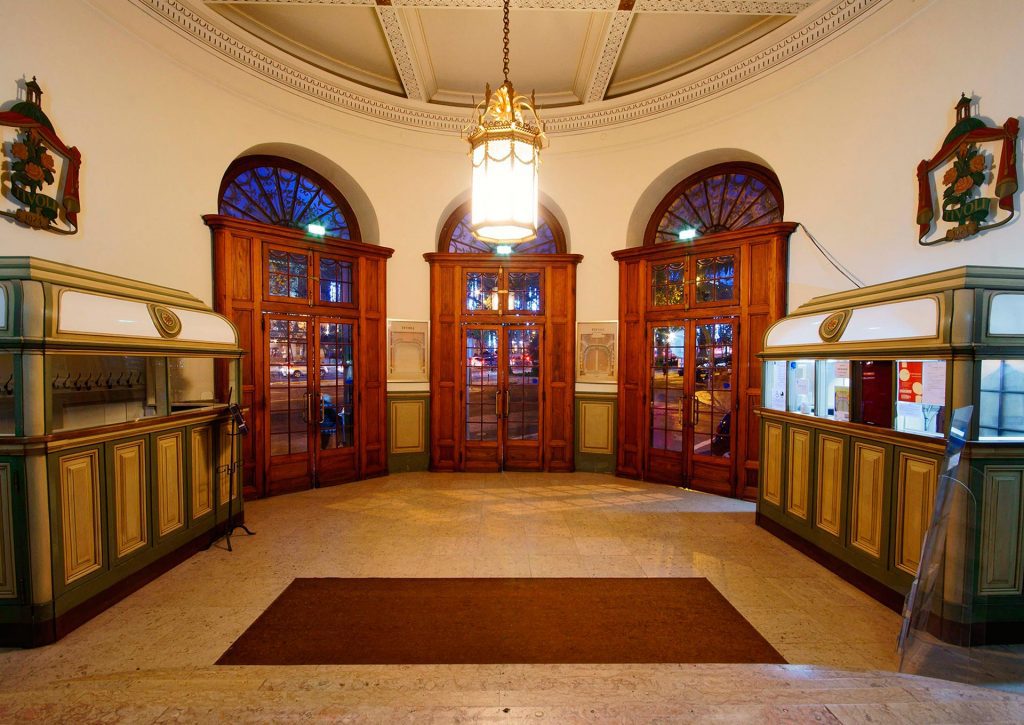
Between the 70s and 90s, the Tivoli Theater had several owners, among them João Ildefonso Bordallo and Emiliano Revilla. During these decades there were some demolition interventions that aimed the transformation of the building into a hotel. These works stopped when, in 1997, Tivoli was classified as a Property of Public Interest and couldn´t be demolished. It reopened in 1999, as the stage for several television programs, advertising spots and occasional shows. At the end of 2011, UAU, a show production company, acquired Tivoli with the aim of recovering, managing and returning it to Lisbon residents. It is the only private Portuguese theater classified as a Public Interest monument since 2015 and was the first Portuguese theater to be named by a corporate company, with the support of BBVA bank. Innovative again, the now Teatro Tivoli BBVA took on a new life and never stopped. The typology of the theater is the opposite scene of the Italian influence, consisting of an audience, friezes, boxes, 1st and 2nd balconies, a stage that is 24.70m wide by 11m deep. Its stage mouth is 13.55m wide by 6.95m high.
Nowadays, its current capacity is 1149 spectators and regards to the decoration in the room we note that the wealth of details decreases as you go up, being practically nonexistent at the level of the 2nd counter, reserved for the lower classes.
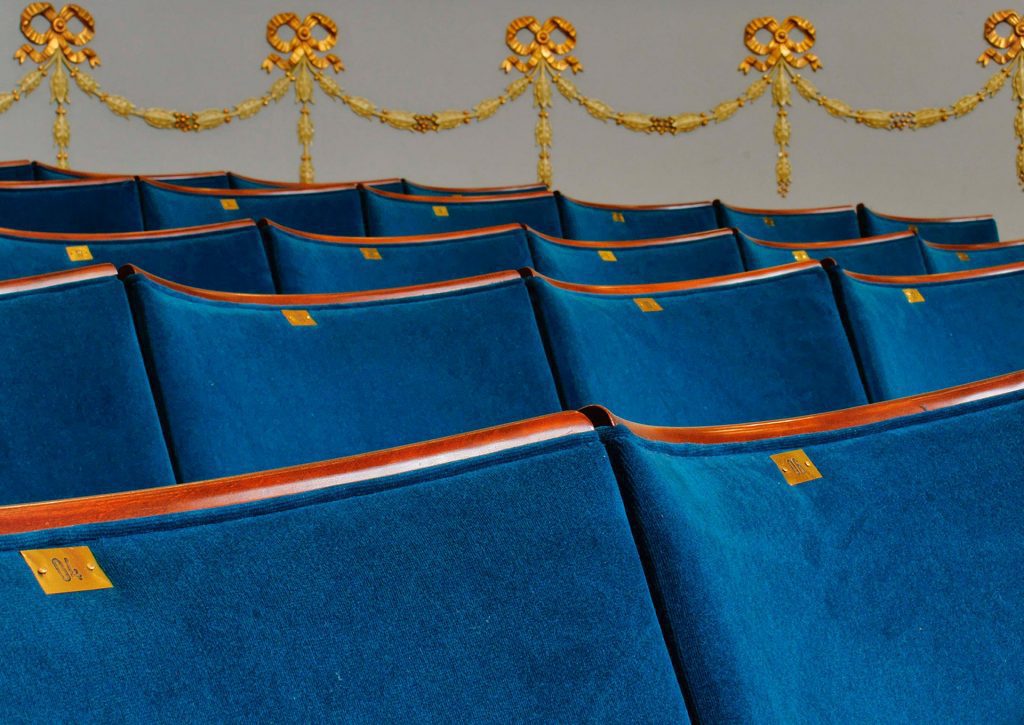
Since 2013, this room has been subject to restoration. We emphasize that the wooden floor is original and the carpets that covered it for decades have been removed. The chair covers were also restored, recovering their original tone. Studies have made it possible to identify the original colors of the walls, a work still in process.
In other areas of the theatre, new dressing rooms were built, equipped with the necessary functionalities and comfort – a rehearsal room, laundry room, new sanitary facilities for public use and office areas. New technical and stage equipment has been acquired in order to be capable of meeting the requirements of any type of show or event. This restoration and modernization required, and requires daily, an increased financial effort to generate the necessary revenues since these costs, totaling 3 million euros, were assumed by UAU, owner of the space, which was supported only by some companies and entities and cannot compete for the Patronage Law.
There is also the Attic, a new area, completely rebuilt from the old storage. With a wide configuration, it has a capacity for 200 to 300 people in small flying or seated events. It is prepared for multimedia presentations and smaller theater or music shows. It has a bar that provides cafeteria service on show days. It is perfect for cocktails or product launch events. As a background, the old projection room, a museum center that keeps the memory of the genesis of our Cine Teatro Tivoli.