



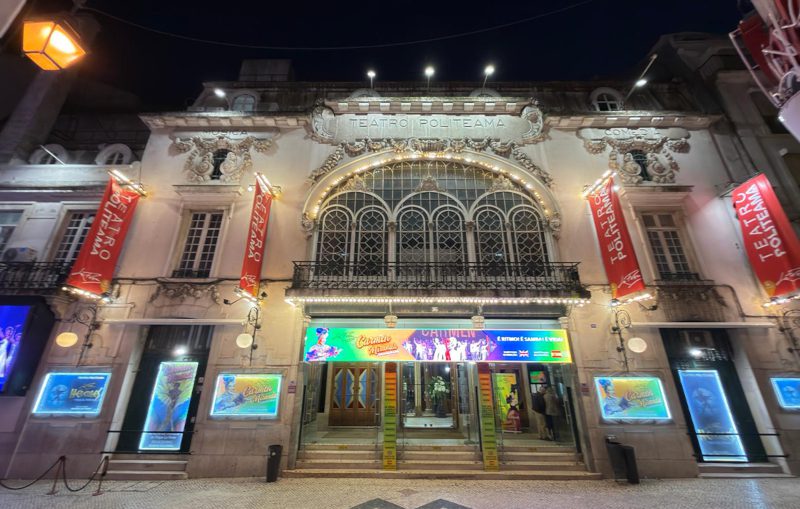
TEATRO POLITEAMA
Teatro Politeama, located on Rua das Portas de Santo Antão in Lisbon, is one of
Portugal’s most emblematic performance venues and a major landmark in the nation’s
cultural heritage. Founded on the initiative of Luís António Pereira and designed by the
architect Miguel Ventura Terra, it was inaugurated in 1913 with the operetta Valsa de
Amor, establishing itself from the outset as a venue dedicated to grand theatrical
productions. The building still preserves important heritage features, including the
original front curtain, decorative paintings and inscriptions commemorating its
foundation.
Throughout the twentieth century, Politeama played a central role in Lisbon’s cultural life.
It hosted leading Portuguese theatre companies and performers, among them Amélia
Rey Colaço, Palmira Bastos and Adelina Abranches. At the same time, it also screened
films, becoming part of Lisbon’s cinema circuit and hosting notable events such as the
Portuguese premiere of Casablanca in 1945. The theatre also served as a stage for radio
programmes, ballet, concerts and major cultural productions.
The contemporary history of Politeama is deeply associated with Filipe La Féria, who
was responsible for the theatre’s revitalisation and modernisation. Under his artistic
direction, the venue became firmly established as “The Theatre of the Great Musicals”,
presenting hugely successful productions such as Amália, The Sound of Music, Jesus
Christ Superstar, West Side Story, FÁTIMA – Rock Opera and Carmen Miranda – The
Great Musical. Today, Politeama stands out for its technical and production capabilities,
functioning as a true house of artistic creation. Classified as a Property of Public Interest,
it remains an essential reference point in Portuguese culture, combining heritage,
innovation and a strong connection with the public.